The Fluff vs. Fat Dilemma: Why Your Eyes Are Lying
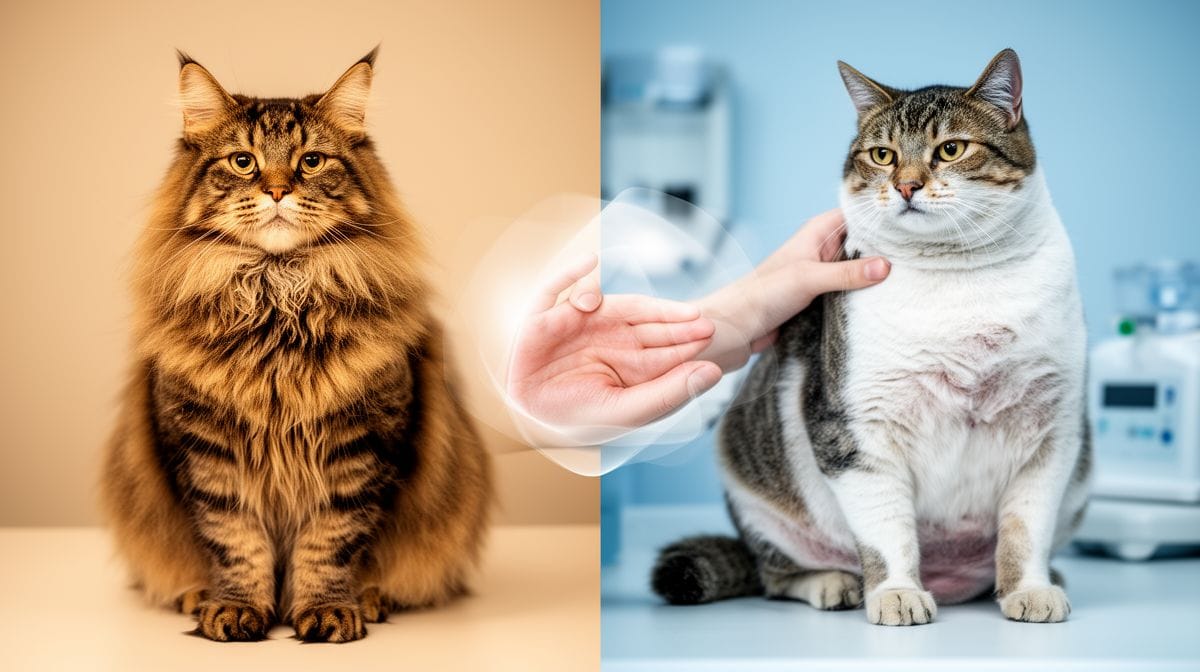
The cat weight assessment process is often obscured by winter coats and breed-specific fur density, leading 55% of owners to misjudge their pet's health. We have all stood over our cats, squinting at their silhouettes, wondering if that extra roundness is fur or food. It's a frustrating trick of the light. Your eyes are wired to see a shape, but a Maine Coon's undercoat is wired to create a lie.
Long-haired breeds create a visual profile that mimics obesity even when the cat is at a perfect physiological weight. You might think your Persian is "chonky," but underneath that cloud of hair, they could be bone and muscle. The "Chonk" aesthetic on social media prevents owners from recognizing clinical health risks like diabetes and arthritis. We love the memes, but the reality is sobering. According to Pet Food Industry, 59% of cats are overweight, yet their owners remain blissfully unaware.
How do I use the 9-Point Cat BCS Chart at home?
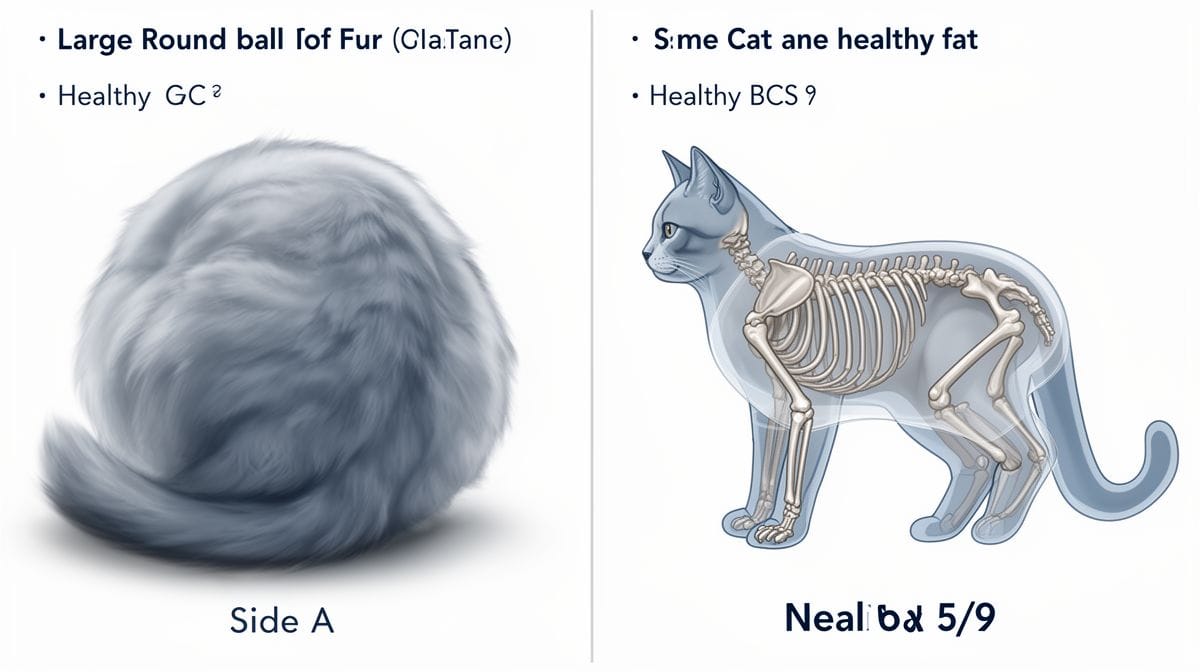
Using the 9-point Body Condition Score (BCS) scale provides a standardized measurement of a cat's fat and muscle independent of their actual weight on a scale. Think of this as the definitive roadmap for your cat's fitness. It's the tool veterinarians use to move past guesswork. You don't need a medical degree to master it, just a willing cat and a pair of hands.
Scores 1 through 3 on the feline BCS scale indicate that a cat is underweight, characterized by prominent ribs and a lack of fat cover. If your cat feels like a bundle of sticks when you pet them, you have a problem. The spine and hip bones shouldn't feel sharp. Muscle loss is often visible here, making the cat look fragile or "wasted."
The Body Condition Score of 4 to 5 represents the "Golden Zone," where ribs are easily felt and a waist is visible from above. This is the sweet spot. When you run your hands along their sides, it should feel like a light layer of padding over a structured cage. There is a slight abdominal tuck when you look from the side. This is where longevity and energy live.
Scores 6 through 9 transition from overweight to obese, requiring significant pressure to find the ribcage beneath dense fat layers. A score of 6 is a warning light. By the time a cat hits a 9, the ribs are buried under a thick, unreachable blanket of fat. Their back becomes broad and flat. Their abdomen sags significantly, and the waist disappears entirely.
flowchart TD
    A[Start: Feel the Ribs] --> B{Easily Felt?}
    B -- Yes --> C{Visible Waist?}
    B -- No --> D[BCS 6: Overweight/Obese]
    C -- Yes --> E[BCS 4-5: Ideal]
    C -- No --> F[BCS 3: Underweight]
The Hands-On Rib Test: Feeling for Fat Through the Fluff
The Rib Test is the gold standard for assessing long-haired cats, requiring the owner to palpate the thoracic cavity with light pressure. Your fingertips are significantly more honest than your vision. You need to get past the guard hairs and the soft undercoat to find the truth. It's a tactile conversation between you and your cat's health.
The "Knuckle Trick" offers a simplified tactile comparison: ideal weight feels like the back of your hand, while obesity feels like your palm. Open your hand and feel the back. Those ridges you feel? That is too thin. Now, feel your knuckles while making a fist; that's what an underweight cat feels like. Finally, feel the fleshy pad at the base of your thumb. If your cat's ribs feel that soft and padded, they are carrying too much weight.
Tactile assessment must be performed weekly to catch "creeping" weight gain early before it stresses the joints. Pets are masters at hiding discomfort. By the time they are limping, the damage is done. Use your weekly grooming sessions as a stealthy health check. VCA Hospitals suggests that this simple habit can add years to your cat's life.

Watch a professional demonstration of the Rib Test and Waist assessment.
Is a sagging belly always fat or just a primordial pouch?
The primordial pouch is a natural, protective flap of skin and fur that exists on all cats, regardless of their weight or body fat percentage. It is the most misunderstood piece of feline anatomy. People see a swing, and they assume a diet is needed. But even the leanest Olympic athletes of the cat world have this "belly flap."
A healthy primordial pouch is soft and swings freely during movement, whereas abdominal fat is firm, dense, and rounded. Think of the pouch as a loose, slightly deflated balloon. It jiggles. It has a life of its own when the cat trots down the hallway. Fat, however, is a solid mass. It doesn't swing; it bulges.
The pouch serves an evolutionary purpose by protecting internal organs during fights and allowing the skin to stretch for massive leaps. It's a tactical advantage. Without it, a cat couldn't fully extend their hind legs during a sprint. As this post by Rainmaker1973 illustrates, even the most powerful wild cats carry this same feature. It's not a flaw; it's a feature.
https://twitter.com/rncominjune/status/1976512639485583715
Proof that the pouch is a healthy, natural part of feline anatomy.
Evaluating Cat Weight by Breed: Maine Coons vs. Siamese
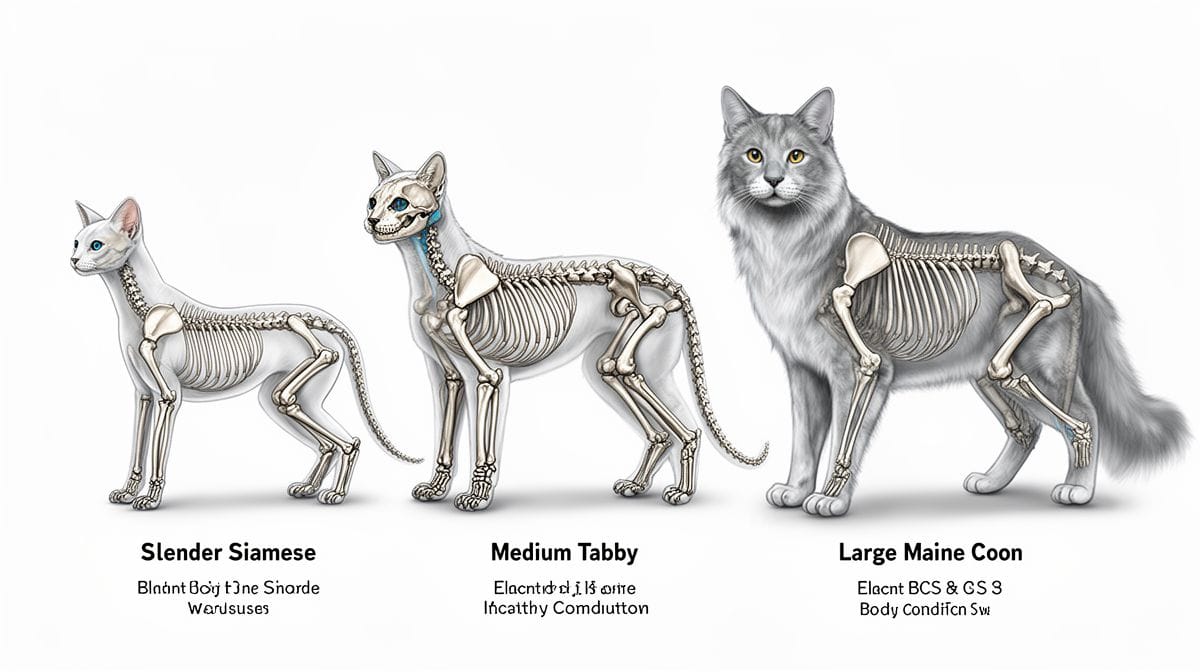
Breed-specific physiology means a healthy cat weight for a Maine Coon can be 18 pounds, whereas that same weight would be morbidly obese for a Siamese. You cannot judge a cat by the number on the scale alone. A massive Maine Coon is built like a linebacker, with heavy bones and dense muscle. A Siamese is a marathon runner, built for speed and lean elegance.
Standardizing weight by pounds is a mistake because owners should focus on the Body Condition Score for the specific skeletal frame. If you put a Siamese on a Maine Coon diet, you are inviting disaster. Conversely, an 18-pound Maine Coon might actually be underweight if they have a particularly large frame. Indoor-only status and neutering significantly increase the risk of obesity in shorthair breeds. These cats have lower metabolic needs. According to the PetMD guide, you must adjust your expectations based on the breed's blueprint.
Common Questions About Feline Weight & Fluff
How can I tell if my long-haired cat is overweight?
Palpate the ribs gently with your flat palm. If you have to press firmly to feel the horizontal ridges of the ribcage, the cat is likely a BCS 6 or higher. The fur may create a rounded silhouette, but the ribs should still be easily detectable to the touch.
Does the primordial pouch mean a cat is fat?
No, every cat possesses a primordial pouch regardless of their obesity status. It is a protective layer of skin and fur located on the lower abdomen. A pouch is loose and jiggly, whereas an obese belly is firm, distended, and does not swing when the cat walks.
Is 15 lbs too heavy for a domestic cat?
It depends entirely on the cat's skeletal frame and breed. For a large breed like a Maine Coon or a Norwegian Forest Cat, 15 pounds could be the ideal weight. For a small-framed domestic shorthair, 15 pounds typically indicates clinical obesity and requires a veterinary consultation.