What makes a dog breed "Zoom-Friendly"?
Choosing a Zoom-Friendly dog breed requires prioritizing anatomical quietness and low reactivity to prevent audio disruptions during professional calls. We’ve all felt that spike of adrenaline. You are mid-pitch, the client is leaning in, and suddenly, your dog spots a pigeon. The resulting acoustic assault doesn’t just annoy your neighbors; it shatters your professional veneer.
Reactivity is the hidden variable here. A dog might only bark once a day, but if that bark is triggered by the precise frequency of a courier’s footsteps, it’s a liability. We differentiate between barking frequency and barking intensity. High-frequency video callers need breeds with a high "stimulus threshold." These are dogs that view the outside world with indifferent curiosity rather than defensive aggression.
According to consolidated expert data from Apartment List, the top quietest breeds aren’t just small; they are temperamentally predisposed to silence. Consider the physiology. Breeds like the Basenji possess a different laryngeal structure. They lack the physical mechanism for a traditional sharp bark. Instead, they emit a "barroo" or a yodel. While unique, this sound carries less "piercing" power through drywall.
When auditing a breed for your home office, look for the "Silent Signal." This is the ability of a dog to signal a need—like a bathroom break—through a nudge or an intense stare rather than a vocal alert. This subtle communication preserves your audio feed while maintaining the bond with your animal.
flowchart TD
    A[Start: Work-Life Balance Assessment] --> B[Bark Frequency]
    A --> C[Independence Level]
    A --> D[Exercise Need]

    B -->|Low| E[Quiet\nGood for Apartments]
    B -->|High| F[Noisy\nNot Ideal for Offices]

    C -->|High| G[Self-Sufficient\nCan Work From Home]
    C -->|Low| H[Needs Constant\nAttention]

    D -->|Low| I[Minimal Walks\nFlexible Schedule]
    D -->|High| J[High Energy\nRequires More Time]

    E --> K[Evaluation Matrix]
    G --> K
    I --> K

    F --> L[Evaluation Matrix]
    H --> L
    J --> L

    K --> M[High Balance Score]
    L --> N[Low Balance Score]

    M --> O[Example: French Bulldog\nLow Bark + Moderate Independence\n+ Low Exercise Needs]

    N --> P[Example: Border Collie\nHigh Bark + Low Independence\n+ High Exercise Needs]
The Work-Life Balance Matrix for Urban Pet Owners
The "Silent Partners": Quiet Breeds for Small Spaces
The French Bulldog and Cavalier King Charles Spaniel represent the gold standard for "Silent Partners," ranking 5/5 for apartment suitability across all major veterinary datasets. These aren't just pets; they are seasoned survivalists in the world of 600-square-foot living. They’ve adapted to the hum of the refrigerator and the blue light of the monitor as their natural habitat.
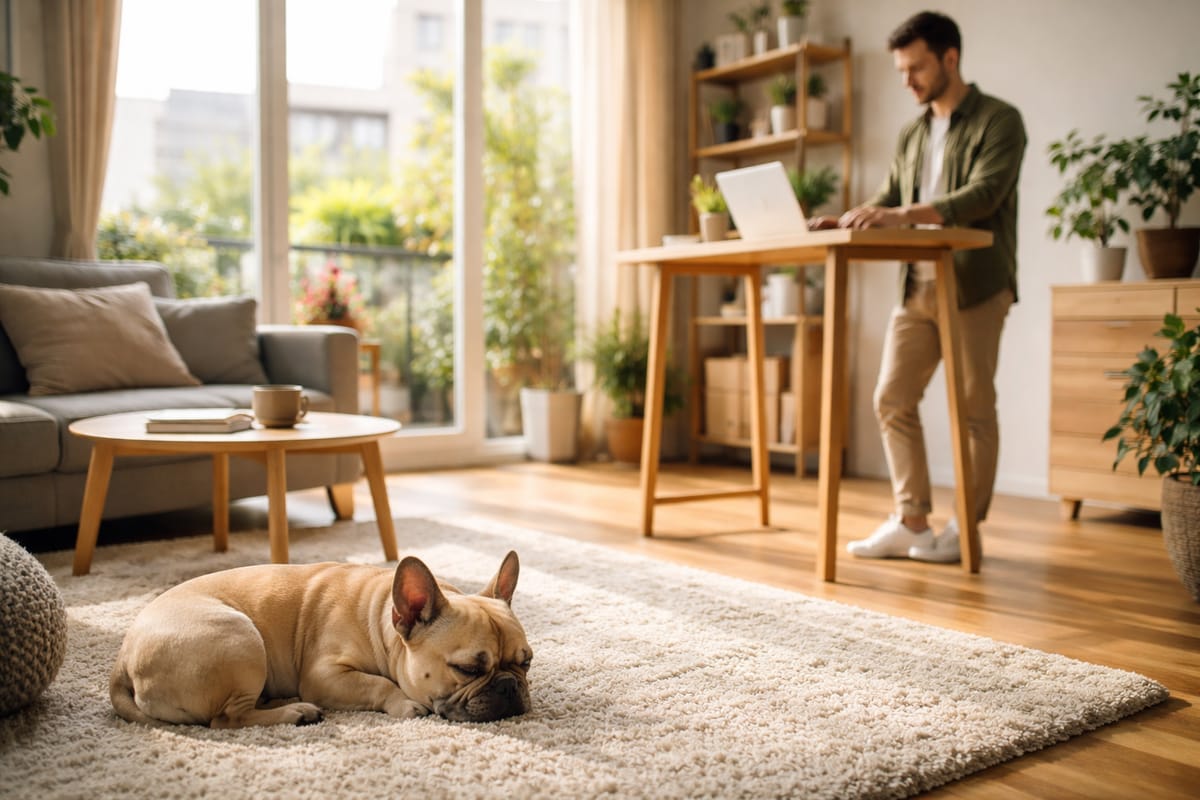
French Bulldogs offer high charm with nearly zero noise—provided you can tolerate the occasional rhythmic snore. Their energy levels are famously low. A twenty-minute walk around the block is often enough to send them into a four-hour slumber. This "nap-first" philosophy is the cornerstone of a successful remote work day. You focus on the spreadsheet; they focus on the sunbeam.
Cavaliers, on the other hand, are the ultimate "Velcro" companions that actually respect the "Mute" button. While they love to be near you, they rarely feel the need to argue with your Slack notifications. Their gentle temperament means they handle the emotional swings of a high-pressure job with a wagging tail rather than a frantic whine.
Trust Beacon: Look at the reality of how these breeds adapt to intense urban environments.
For the professional, the "Frenchie" provides a grounding presence. They are sturdy but compact. They don't knock over floor lamps during a frantic greeting. They are built for the corners of a home office. However, we must address the cost of this silence. Their brachycephalic (flat-faced) nature means they struggle with heat and intense cardio. If you live in a top-floor walk-up without climate control, their breathing—not their barking—becomes the primary acoustic concern.
Can a large dog actually thrive in a studio apartment?
Contrary to popular belief, large breeds like Greyhounds are more compatible with apartment-based remote work than many small terriers due to their high sleep requirements. The "size equals energy" myth is a trap many first-time owners fall into. They buy a Jack Russell Terrier because it "fits" the floor plan, only to find they’ve invited a kinetic explosion into their office.
Enter the Greyhound, often called the "40 mph Couch Potato." These animals are built for a massive burst of speed followed by twenty hours of horizontal living. Once they have had their morning sprint, they effectively turn into living rugs. They are remarkably thin and can tuck themselves into a corner with surgical precision. Unlike the frantic pacing of a smaller herding dog, a Greyhound’s presence is almost spectral. They move silently through the house, rarely knocking anything over.
Data from Rover’s Lazy Dog Breeds confirms that Greyhounds sleep upwards of 18-20 hours a day. For a coder or a writer, this is the Holy Grail. You get the majesty of a large dog without the constant "throw the ball" stares that come with a Golden Retriever.
Great Danes offer a similar paradox. Known as the "Lazy Giant," these dogs are actually better for neighbors than a "yappy" small breed. Their bark is thunderous, yes, but they almost never use it. They are constitutional pacifists. A Great Dane in a studio apartment isn't a space problem; it's a furniture problem. If you can fit a king-sized mattress, you can fit a Dane. They occupy space with a quiet, regal stillness that lowers the collective cortisol of the room.

The "Independent Colleague": Breeds for Deep Work
Success in deep-work sessions hinges on selecting "Independent Colleague" breeds like the Shiba Inu or Basenji, which offer companionship without needing constant touch. We call this "proximity without pressure." Most remote workers want a dog that sits in the same room but doesn't feel the need to sit on the keyboard.
The Basenji: The Barkless Minimalist
This breed is the feline of the canine world. The Basenji is famously barkless, but its value for the remote worker goes deeper. They are fastidiously clean—they groom themselves like cats—and they don't have that "doggy smell" that can overwhelm a small apartment. During a work sprint, a Basenji will often find a high vantage point (like the back of a sofa) and watch you work with detached respect. They don’t suffer from the separation anxiety that plagues more dependent breeds. They are content in their own company, which allows you to be content in yours.
The Shiba Inu: Cat-Like Independence
The Shiba Inu is a master of the "side-eye." They are fiercely independent and possess a legendary "Shiba-tude." This works in your favor during a long day of meetings. A Shiba doesn't need you to entertain them constantly. In fact, they might prefer that you don't. This lack of "clinginess" makes them one of the few breeds that doesn't view your closed office door as a personal insult.
Comparative Analysis: Work-From-Home Suitability
The following table analyzes breed ROI for remote workers. This data is structured for user comparison based on the specific pressures of an urban home office.
| Breed | Noise Level | Independence | Daily Exercise | Best For |
|---|---|---|---|---|
| Basenji | Very Low (Yodels) | Very High | 45-60 Mins | Experienced Owners |
| Frenchie | Low (Snores) | Moderate | 20-30 Mins | Tiny Studios |
| Greyhound | Silent | High | 30 Min Sprint | Large Living Rooms |
| Cavalier | Very Low | Low (Velcro) | 30-40 Mins | First-Time Owners |
| Pug | Low | Moderate | 20 Mins | Humor & Chill |
| Shiba Inu | Low | High | 60 Mins | Deep Work Junkies |
Trust Signal: These ratings are distilled from the AKC Apartment Guide and veterinarian-verified behavior profiles.
How to manage the "Velcro Dog" while staying productive?
Direct intervention through mental puzzles and scheduled boundaries allows even affectionate breeds to thrive without disrupting the work schedule. Just because a breed is "apartment-friendly" doesn't mean it’s "unsupervised-friendly." High-intelligence breeds, even quiet ones, can turn to destructive chewing if their brain isn't engaged while you are in a flow state.
The secret to a 9-to-5 peace treaty is the "Independence Gap." This is the time between your dog waking up and you finishing your first meeting. Bridge this gap with lick mats and frozen Kongs. The act of licking is a self-soothing mechanism for dogs; it lowers their heart rate and releases endorphins. A well-prepared lick mat can buy you 30 minutes of absolute silence during a high-stakes call.
You must also establish "Office Hours." Dogs are masters of pattern recognition. If you provide attention every time they nudge your elbow, you are training them to interrupt you. Instead, use a physical marker—like a specific rug or a "work-only" dog bed. Once you are at your desk, the dog stays on the marker. When you stand up for a break, the boundary dissolves. This clarity reduces the dog’s anxiety because they know exactly when you are available for a belly rub and when you are "at work."
FAQ: "People Also Ask"
Which dog breed is the quietest for Zoom calls?
The Basenji is physically the quietest due to its unique larynx, which prevents traditional barking. For those who prefer a more traditional look, the French Bulldog and Italian Greyhound are exceptionally quiet "alert" dogs that rarely bark at environmental stimuli.
Can I get a puppy while working remotely?
It is risky. Puppies require constant attention and have unpredictable energy spikes. Experts and community users on Reddit recommend adopting an adult dog (2+ years). At this age, their energy level is baked-in, allowing you to choose a "couch potato" temperament that matches your work schedule from day one.
Future Outlook: The Urban Remote Work Breed Trends of 2026
Emerging data for 2026 points to a surge in Hypoallergenic Hybrids (like the Bernedoodle or Cockapoo) as the preferred "clean office" companion for urban professionals. As more companies transition to permanent remote models, the "low-shed" requirement is becoming as important as the "low-bark" requirement. No one wants to spend their lunch break vacuuming dog hair off their ergonomic chair.
We are also seeing a shift in how shelters market dogs. The term "WFH-Compatible" is moving from a buzzword to a formal classification. Adoption agencies are now testing for "screen reactivity"—how a dog responds to the sound of voices coming from a speaker. This specialized vetting ensures that the bond between worker and animal doesn't become a source of professional friction.
Your Monday morning action is simple: stop looking at size and start looking at "off-switches." Whether it’s a retired racing Greyhound or a stoic Shiba Inu, the key to a harmonious home office is a dog that prioritizes sleep over drama. If you are ready to adopt, look for senior dogs or retired racers. They’ve already done their running; they are just waiting for a quiet place to watch you work.