Decoding Dog Sleeping Positions and Their Meanings
Dog sleeping positions are high-fidelity indicators of a canine's emotional security and physical recovery status. When you walk into the living room and see your companion sprawled in a specific way, you aren't just looking at comfort. You are looking at a roadmap of their mental health and ancestral history.
Take the Side Sleeper. This is perhaps the most common pose for a happy, well-adjusted dog. In this position, the limbs are extended and the body is completely relaxed. From a biological standpoint, this indicates the dog has entered the deep REM (Rapid Eye Movement) stage of sleep. Because their legs are exposed and their vitals aren't protected, a dog only sleeps like this when they feel a 10/10 level of safety. Personality-wise, these dogs are typically loyal, easy-going, and possess a strong bond with their pack. They don't feel the need to stay on "high alert."
In contrast, consider the Superman pose. You've seen it: belly down, front legs stretched forward, back legs stretched behind. This is the hallmark of the "high-energy" pup. It isn't just a stretch; it's a strategic choice. By keeping their belly in contact with the ground while their limbs are ready to pivot, these dogs are signaling they are only "napping." They are ready to spring into action if a treat hits the floor or a squirrel passes the window. These dogs are generally playful and require significant mental stimulation.
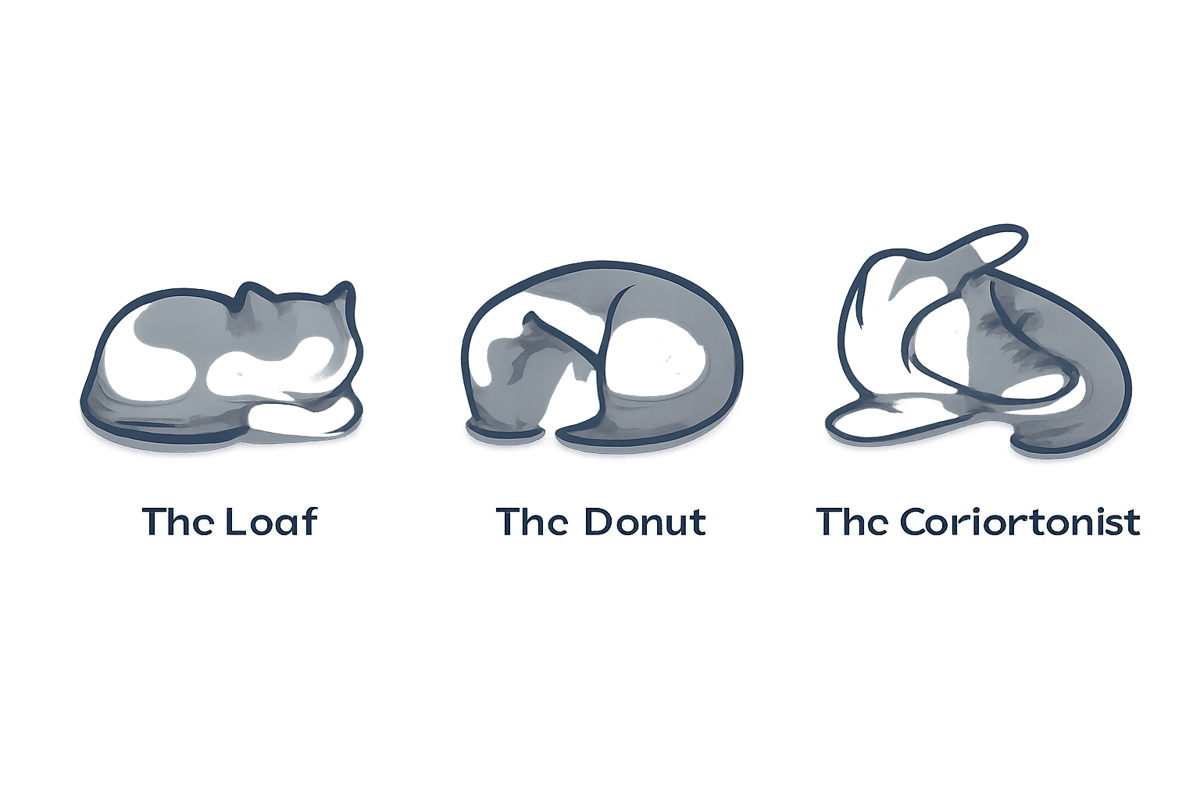
Then there is the Donut (or the Curled Ball). This is where evolution takes the wheel. By tucking their limbs close to their body and resting their nose on their tail, a dog is protecting their most vulnerable organs from predators while simultaneously conserving body heat. In the wild, this was the survival gold standard. If your dog favors this pose even in a warm house, they might be naturally more cautious or gentle. It's also common in dogs that are still adjusting to a new home environment—they are literally "circling the wagons" around their own heart and stomach.
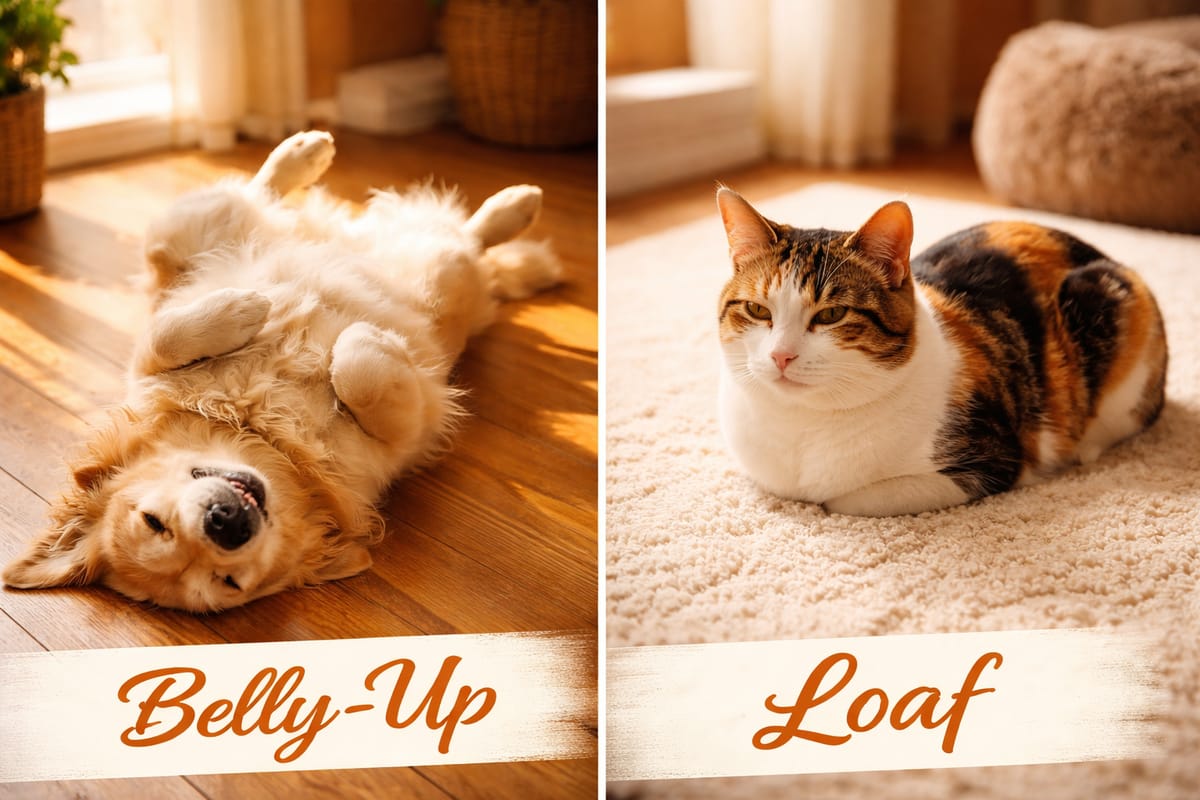
One of the most beloved community-identified poses is what Reddit users on r/AustralianCattleDog call "Crazy Legs." This is the belly-up, legs-in-the-air contortion. Owners often celebrate "Crazy Legs" as the ultimate milestone of a dog's trust in a new home. It represents the total abandonment of defensive posture.
flowchart TD
    A[Low Trust: The Donut\nCurled in a tight ball] --> B[Moderate Trust: The Sphinx\nUpright with paws tucked] --> C[Total Trust: Belly-Up/Crazy Legs\nCompletely exposed]
The Pet Trust Hierarchy: From Survival to Security.
Why does my dog sleep on his back with paws up?
Sleeping belly-up is a dual-purpose behavior used for both cooling the body and signaling absolute vulnerability. It is the canine equivalent of saying, "I have zero worries in this world."
The first driver is Thermoregulation. While humans sweat from almost everywhere, dogs are much more limited. They primarily dissipate heat through panting and the sweat glands located in their paw pads. By lying on their back and extending their paws into the air, they are maximizing the surface area exposed to airflow. The fur on a dog's belly is also significantly thinner than the fur on their back. When they expose this "cooling panel" to the room, they can lower their core temperature much faster than they could while curled up.
The second driver is the Psychological Safety Shield. In the animal kingdom, the abdomen is the "soft target." It contains all the vital organs and has no bony protection like the ribcage or skull. When a dog sleeps with this area exposed, they are effectively shutting off their predator-defense blueprints. This position is almost never seen in the wild or in stray populations. If your dog sleeps this way regularly, you've done something right. You have created an environment so low-stress that their brain allows them to ignore thousands of years of survival programming.
According to veterinary research from PetMD, this position is most frequently adopted by breeds that are naturally confident and playful. It's the "extrovert" pose of the dog world. They aren't just comfortable; they are making themselves the center of the room, even while unconscious.
Feline Postures: The Hidden Language of Cat Nap Positions
Cat sleeping positions prioritize warmth-seeking and vigilance, reflecting their roles as both predators and prey. Unlike dogs, who are primarily social sleepers, cats are solitary hunters by DNA. Their sleep poses are often a masterclass in tactical geometry.
The Loaf Pose is the quintessential feline icon: paws tucked, tail wrapped, sitting upright but eyes closed. This isn't deep sleep; it's an "idling" state. In the loaf, a cat is relaxed but their weight is perfectly balanced over their paws. If a threat appears, they can launch into a full sprint in less than a second. This pose indicates an observant, independent personality. They want to be in the room with you, but they aren't ready to let their guard down completely.
Then you have the Contortionist. These are the sprawled, awkward, almost "broken-looking" poses where a cat’s head is twisted one way and their hips another. This signals that the cat views your home as a perfect "den". Because cats are incredibly flexible, these positions allow them to decompress their spine and relieve pressure on their joints. It’s a sign of a cat that is highly confident in their territory. They don't just live in your house; they own it.
Interestingly, there is a fascinating scientific nuance to feline sleep: the Left-Side Preference. Studies have shown that roughly 2/3 of cats prefer sleeping on their left side. Why? It’s believed to be linked to neurological "lateralization." Sleeping on the left keeps the right hemisphere of the brain—the side responsible for processing threats and environmental changes—more "active" or primed. Even in their sleep, your cat is a finely tuned radar system.
How does temperature influence how your pet sleeps?
Biological drivers like heat conservation and dissipation often override personality traits in choosing a sleep pose. We often try to read deep psychological meaning into every twitch, but sometimes, your pet is just reacting to the thermostat.
Cats are notorious Heat-Seekers. Their "thermoneutral zone"—the temperature range where they don't have to spend energy to stay warm or cool—is between 86°F and 100°F. Most human homes are kept around 68°F to 72°F. To a cat, your air-conditioned living room feels like an Arctic tundra. This explains the constant "Donut" pose or the tendency to burrow under blankets. They aren't necessarily feeling insecure; they are just trying to stop their core temperature from plummeting during the metabolic slowdown that happens during sleep.
Dogs use sleep poses as Active Cooling Strategies. During the summer, you will see a massive uptick in the "Superman" (belly-down on tile) and "Side Sleeper" poses. By pressing their belly against cold surfaces like hardwood or tile, they utilize "conduction" to pull heat away from their body. If you notice your dog has stopped sleeping in their plush bed and is now sprawled on the kitchen floor, it’s a signal that they are struggling with the ambient temperature. It’s a micro-workflow for owners: when you see the sprawl, it might be time to turn on a fan or provide a cooling mat.
When to Worry: Sleep Position Shifts and Health Red Flags
Monitoring shifts in sleep behavior is one of the most effective ways to spot health issues before they become emergencies. Pets are masters at masking pain—it’s a survival instinct to avoid looking vulnerable—but their sleep positions rarely lie.
The "Red Flag" Checklist:
- The Transition to Guarded: If your dog was a lifelong "Belly-Up" sleeper and suddenly only sleeps in a "Donut" or a hunched "Sternal" position (sitting upright while sleeping), this often indicates arthritis or joint pain.
- The Head Press: If you find your pet sleeping with their head pressed firmly against a wall or furniture, this is a neurological red flag. It can indicate high blood pressure or even brain issues.
- Pacing and Settling Difficulty: If a pet circles 20 times, lies down, and then immediately gets up to move, they are likely experiencing internal discomfort or neurological "restlessness."
- Sudden Back-to-Back Seeking: While often a sign of trust, a senior pet suddenly needing constant physical contact during sleep may be dealing with vision loss or cognitive decline, seeking your "presence" to orient themselves.
Expert advice from VCA Hospitals suggests that sleep aggression (growling when woken) and a total shift away from deep REM positions (side-sleeping) can be early indicators of age-related cognitive decline.

Dog vs. Cat Sleeping Habits: Key Differences
While both species use sleep for recovery, their evolutionary paths create distinct habits. Dogs are social-pack sleepers; they seek the "touch" of another living being to feel safe. Cats are vigilance-sleepers; they seek "height" and "sightlines" to feel safe.
| Aspect | Dogs | Cats |
|---|---|---|
| Primary Driver | Pack Trust & Cooling | Heat Seeking & Vigilance |
| REM Cues | Heavy limb twitching, "running" | Subtle ear/whisker twitches |
| Social Preference | Physical touch (social bond) | Proximity without contact |
| Vulnerability | High (often exposes belly) | Moderate (rarely exposes belly) |
| Brain Activity | Symmetrical | Lateralized (Left-side biased) |
Common Questions About Pet Sleeping Habits
Why does my dog sleep with his tongue out?
This is usually a sign of profound relaxation. When a dog enters the deepest stage of REM sleep, their muscles lose all tension—including the muscles that keep the tongue in the mouth. In some cases, it's also a trait of "hanging tongue syndrome," common in smaller breeds or those with specific jaw structures.
Is it normal for cats to sleep with their eyes half-open?
Yes. This is a predatory instinct called "unihemispheric slow-wave sleep." It allows one half of the brain to rest while the other half remains alert to movement or sound. It’s the feline equivalent of sleeping with one eye open to stay ahead of trouble.
Does sleeping back-to-back with me mean my pet trusts me?
Absolutely. In the wild, "protecting the six" (your back) is a task reserved for only the most trusted pack members. When your pet sleeps with their back against you, they are telling you they trust you to watch the area they can't see, representing the ultimate social bond.
Monday Morning Action: Take a photo of your pet's sleep position tonight. Compare it to this guide. If they are "Donut-ing" in a 70-degree room, they might just need a cozy blanket. If they are "Crazy Legging," give yourself a pat on the back—you've built a sanctuary of trust.